EN
EN  PT_BR
PT_BR 
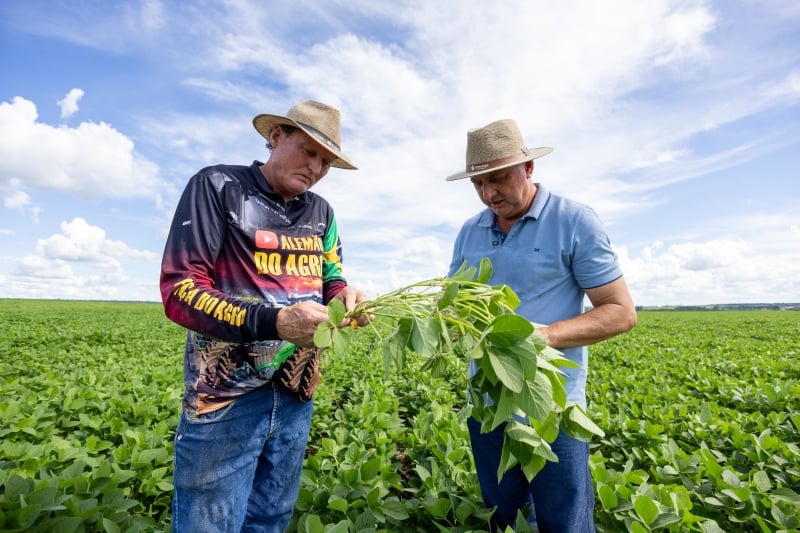
The Mato Grosso Soybean and Corn Producers Association (Aprosoja MT) began another week of the Mato Grosso Climate and Market series this Monday (November 24th). In this 5th episode, the organization visited the Diamantino, São José do Rio Claro, and Nova Maringá regions to show the reality of the 2025/26 harvest in different areas of the state, in a challenging scenario with recurring rainfall irregularities and operational difficulties.
The organization's vice-president for the western region, Gilson Antunes de Melo, highlighted that the series seeks to give a voice to those who live the day-to-day reality of farming. “No one is better suited than the producer to talk about their reality, the problems they are facing, the difficulties. When this information reaches other producers, and with even greater accuracy because many are sharing what is happening in each region, it sets the standard not only for the state's reality but also for the market, because we can anticipate information that could influence a drop in production,” says the rural producer.
In the Diamantino region, producer Rodrigo Konagesk explained that the unstable weather has completely disrupted the harvest season.
“This year we had unstable weather. Today we are on a farm that was our last planted area, and here we only had the first rain, the kind that would give us the security to start planting, on October 24th. With this production window, this is a property where we risk not having a planting window for the second crop. We will have to do a lot of calculations and check the trends for the next harvest, since it will not be economically viable or viable because it was completely outside the ideal planting window,” he stated.
In the region, producers report uneven emergence in many crops, as well as the need for replanting and the risk of development falling short of expectations. “We have the planting done, but without the assurance of ideal productivity. Overall, we will have good areas and others that will fall short. I don't believe in very high average yields for soybeans this season,” assessed Rodrigo.
The scenario is repeated in São José do Rio Claro. The coordinating delegate of the unit, Fabrício Portilho, says that the delay in continuing planting reduced the plant stand, led many producers to replant, and made weed control more difficult, in addition to affecting productivity expectations.
“Planting this year was much later than in previous years due to the weather. We had delays, the need for replanting, and a lower plant stand. I say this on behalf of the entire São José do Rio Claro region, which is in the same situation. Today, pesticides are not responding well; we are having difficulty controlling weeds, largely due to the low metabolism of the plants, the low water content in the system, and the excessive heat. Pests are also attacking strongly and are difficult to control. It is an expensive crop, with many challenges, and which, in my assessment, should have low productivity and high costs,” he reports.
Furthermore, the producer explains that the concern already extends to the second crop, since the corn planting window will be short. “We know we're going to have a tight window for corn, resulting in significant losses and high costs. We have to buy inputs, and it's an uncertain reality; we don't know the size of the area I'll be able to grow corn in. As everyone knows, the market is very dynamic; we have to make decisions early and we're at the mercy of the weather and the market,” he states.
In Nova Maringá, the scenario was different even within the municipality itself. Producer Valdecio Schwade explained that the areas closest to the city were favored at the beginning of the harvest, with good rains between the end of September and the beginning of October, allowing planting to progress. However, in more distant properties, rainfall was not regular.
“Here, in the areas near the city, we were blessed with good rains at the beginning, which continued for a few days. But we have reports from producers 10, 15 kilometers from here who did not receive the same amount of rain. In these regions, there were delays in planting and even cases of replanting. Many crops were left behind, and producers only managed to plant in the last few days. Within the municipality, we have areas with more difficulties, with lack of rain and low humidity,” he said.
The coordinating delegate of the Nova Maringá center, Lazaro Pletsch, reported the impact of extreme heat and low humidity on crop management in the region. “What we also noticed here was the lack of efficiency of many pesticides, especially post-emergent ones, due to the excessive heat and low humidity in the air. We had many problems with phytotoxicity in various parts of the municipality,” he explained.
With over 400 kilometers traveled this Monday, the MT Clima e Mercado project shows that even in different municipalities, the 25/26 harvest has been marked by major challenges that could affect the state's production. This Tuesday (November 25th), Aprosoja MT will travel through the Tangará da Serra and Campo Novo do Parecis regions, showing firsthand the reality of the crops in the western region.