EN
EN  PT_BR
PT_BR 
During the international forum “The Altiplano and the new agricultural map of Colombia”, the superintendent of the Federation of Agriculture and Livestock of Mato Grosso (Famato) and the Mato Grosso Institute of Agricultural Economics (Imea), Cleiton Gauer, presented the Mato Grosso case as a reference for the development of soybean and corn production in the Colombian Altiplano, a region very similar to the Mato Grosso Cerrado.
The agricultural development model of Mato Grosso was presented as an international reference during the forum “Colombia: an agricultural power that will feed the world”, held on Wednesday (8), by the newspaper El Tiempo, in Colombia. The event brought together experts, productive leaders and representatives of the Colombian agro-industrial sector to discuss ways to expand soybean and corn production in the Altillanura region, an area considered strategic to reduce the country's dependence on grain imports.
Invited to present the Mato Grosso experience, Cleiton Gauer highlighted the state's trajectory in building a large-scale production model based on technology, entrepreneurship, soil correction, mechanization, logistics, and legal security.
Mato Grosso's participation in the debate comes at a time when Colombia is discussing alternatives to strengthen its domestic grain production, especially corn and soybeans, which are fundamental inputs for sectors such as poultry farming, pig farming, and animal protein production. Currently, according to the Colombian press, the country still imports a large part of these products, despite the existing agricultural potential in the departments of Meta and Vichada, in the Orinoquia region.
According to Cleiton Gauer, the similarity between the Colombian Altillanura and the Brazilian Cerrado helps explain the interest in the Mato Grosso case.
“The Altillanura region has characteristics that are very similar to the Brazilian Cerrado. Colombia is looking to Mato Grosso because the state has managed to transform similar challenges into a strong, competitive, and market-integrated productive base. Of course, each country has its own reality, but Mato Grosso's experience shows that, with planning, legal security, technology, and infrastructure, it is possible to move forward,” he stated.
During the presentation, Cleiton showed that Mato Grosso occupies a prominent position in Brazilian and global agribusiness. The state is a national leader in the production of soybeans, corn, cotton, corn ethanol, cattle, and sesame. Agribusiness represents 56.21% of Mato Grosso's GDP, and Imea's projection for 2026 indicates a Gross Production Value of R$208.35 billion.
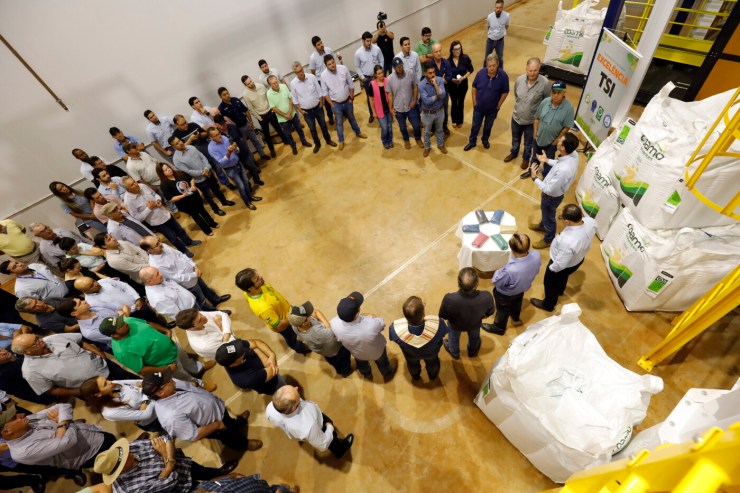
Famato and Imea present a success story from Mato Grosso.
In the case of soybeans, Mato Grosso is expected to account for 28.6% of Brazilian production and 11.7% of world production in the 2026/27 crop year. As for corn, the state represents 38% of national production and 49.5% of Brazil's second crop, according to estimates presented by Imea.
In addition to the production figures, the superintendent highlighted that Mato Grosso's growth occurred through the integration of production and preservation. According to data from Imea, 60.4% of the state's territory is made up of remnant vegetation, with 40.43% corresponding to vegetation protected or preserved by rural producers.
Superintendent Cleiton Gauer presented the agricultural potential of Mato Grosso.
“Mato Grosso has learned that it is not enough to produce more. It is necessary to produce efficiently, with environmental responsibility and with a long-term vision. Inside the farm gate, the producer has advanced a lot in technology, management and productivity. The major bottlenecks today are mainly outside the farm gate, such as logistics, infrastructure, bureaucracy and legal security,” Cleiton pointed out.
These challenges also appear in the Colombian debate. The local press points to obstacles such as the lack of genetic material adapted to the tropics, the need for liming to correct acidic soils, the precarious infrastructure of roads and bridges, as well as land conflicts and legal uncertainty regarding land ownership.
According to Cleiton, these points were central to the forum discussions and reinforce the importance of consistent public policies to transform productive potential into real competitiveness.
“Large-scale agricultural production requires much more than just available land. It requires roads, bridges, access, credit, research, technology, legal stability, and a favorable business environment. Mato Grosso has faced and continues to face many of these challenges, but it has managed to move forward because there has been investment, productive organization, and the leadership of the producers,” he emphasized.
Logistics was another point of connection between the two countries. In Mato Grosso, despite advances in the flow of goods through the Northern Arc, which will account for 52,61% of grain movement in 2025, the cost of transportation is still one of the main factors in the loss of competitiveness. For Imea, this bottleneck also represents an opportunity for new road, rail, and waterway projects.
Despite the challenges, Mato Grosso is a benchmark in agriculture.
In Colombia, the debate on infrastructure is considered crucial to enabling the agricultural expansion of the Altillanura region. The region has suitable areas for cultivation, but faces difficulties with access, poor road connectivity, and a need for long-term investments.
The forum also addressed the relationship between grain production and food security. The expansion of soybean and corn production is seen by the Colombian agricultural sector as a condition for reducing costs, strengthening poultry and pig farming, and increasing the supply of animal protein to the population.
For Cleiton Gauer, the exchange of experiences reinforces Mato Grosso's role as an international benchmark in tropical agriculture.
"Mato Grosso shows that agricultural frontier regions can develop with scale, technology, and preservation. Colombia has a great opportunity ahead, and our role was to share lessons learned, including the challenges, to contribute to this debate," he concluded.