EN
EN  PT_BR
PT_BR 
Before even knowing what a harvest, no-till farming, or crop rotation is, every rural producer was once a child with their feet on the ground and their head full of questions. Where does popcorn come from? How does soy become food? It is to answer questions like these that Futuro em Campo introduces students from different parts of the state to the daily routine of agribusiness. On this Children's Day, celebrated on October 12th, the Mato Grosso Soybean and Corn Producers Association (Aprosoja MT) honors the little ones who are part of this journey.
This year, the program has already had more than 1,452 participants in nine editions, held in Porto Alegre do Norte, Sorriso, Gaúcha do Norte, Santa Carmem, Vera, Nova Mutum and Alto Garças.
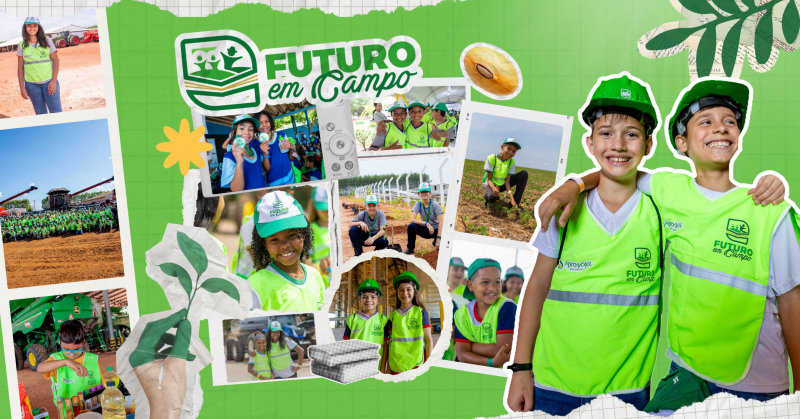
According to Ilson José Redivo, Vice-President for Northern Mato Grosso of Aprosoja MT, the program is successful in working with those who are still in training and who can, through this experience, see the field in a different way. “Children are the continuation of our lives; the future of Brazil is in their hands. Showing them the benefits that agriculture brings to Brazil and the world sparks interest in the sector and, sometimes, even the desire to pursue a career related to agriculture. By investing in children, we are investing in the future,” he states.
Redivo cites an example of what he has seen happen. “After participating in the Future in the Field program, a boy said he wanted to be an agronomist and work in agriculture. The project awakens a greater aspiration in children because it shows the importance that agriculture has in people's lives, whether they are in the countryside or in the city,” he reports.
The coordinating delegate of the Aprosoja MT branch in Sorriso, Aline Beledelli, attends the events and feels a different emotion with each visit. “It’s a very rewarding experience for me. I’m surprised by each event. Seeing the children learning firsthand about the importance of the countryside and understanding how food is produced strengthens the connection between the city and the countryside,” she says.
More than just a visit, the goal is for the learning to extend beyond the school gate. Aline believes that the children take home much of what they experience in the program. “The children have a fundamental role, I always say that. They have fresh minds, a great desire to learn, and in the future they will also be disseminators of knowledge. They share everything they learn that day with their families and friends and help to spread accurate information about agriculture. They are truly the bridge between the school and the community where they live,” she emphasizes.
It is precisely this bridge that makes childhood the starting point for the next generation in the field. Among the children who this year touched the land, observed the crops, and discovered the path of food to the table, may be the future producers, agronomists, researchers, and technicians who will lead agriculture in Mato Grosso in the coming decades.
For them, Aline leaves a special message on this date. “If I can leave a message for the children on this Children's Day, it's that you should never stop dreaming and learning. Agriculture has many opportunities for those who are dedicated, curious, and willing to make a difference. The future of the countryside is certainly in the hands of this new generation,” she wishes.