EN
EN  PT_BR
PT_BR 
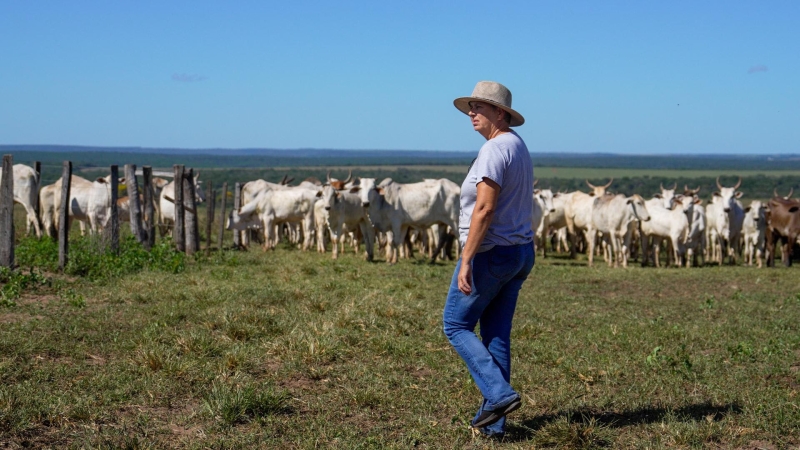
Long before agriculture became an economic powerhouse in Mato Grosso, women were already helping to build the sector behind the scenes on farms, in offices, and on rural properties in the state. Between spreadsheets, cattle handling, farming, and raising children, many of them directly participated in transforming Mato Grosso's livestock industry into one of the largest in the world.
This is the case of rural producer Leane Altmann, from Nova Mutum, who arrived in Mato Grosso in the late 1980s with her husband in search of opportunities in the state's interior. Newly graduated and recently married, she traded the South of the country for a region that was just beginning to develop economically.
Initially working only in agriculture, the couple began investing in livestock farming after acquiring a rural property suitable for cattle raising. Since then, the activity has become part of the family's routine.
Today, in addition to the agricultural areas in Nova Mutum, the family also maintains a property dedicated exclusively to livestock farming in Santa Rita do Trivelato. Throughout her career, Leane has balanced motherhood, farm management, and active participation in industry organizations.
“When the children were small, I focused more on the administrative side and I was also president of the Rural Union of Nova Mutum. My husband took care of the farm more from the gate inwards,” she says.
As the children grew up, the producer also took on the management of agricultural properties, while the couple shared the administration of the family business.
Despite her strong connection to agriculture, Leane says she never pressured her children to follow the same path. Even so, two of them are already directly involved in the family business, and the youngest is considering staying in the sector. “I never imagined I would have all three boys as successors. Today I see my children proud of the work, and that makes me very happy as a mother.”
For her, one of the main changes in recent decades has been precisely the increased value placed on agricultural activity and the figure of the rural producer. “Today, agriculture has a lot of technology. The producer has gained value, and the family has also come to value this activity. This helps keep new generations in the countryside.”
In addition to family succession, the producer highlights the economic challenges faced by the sector, marked by market fluctuations, high costs, and a constant need for adaptation. "I work in agriculture by choice. It's an economic activity that needs to be profitable, but it also brings me personal satisfaction."
The executive director of the Mato Grosso Institute of Meat (Imac), Paula Sodré Queiroz, highlights that the presence of women has been gaining increasing strength in Mato Grosso's livestock industry, both in the management of properties and in the adoption of sustainable and modern practices.
"The female cattle rancher in Mato Grosso today is not just a supporting player; she plans, she decides, she supports families and businesses, being one of the great forces of our agribusiness," says Paula.
She further emphasizes that stories like Leane's represent a generation of women who helped consolidate Mato Grosso as a national benchmark in food production. "On this Mother's Day, it's important to recognize these women who not only helped build families, but also participated in building the state's livestock industry."