EN
EN  PT_BR
PT_BR 
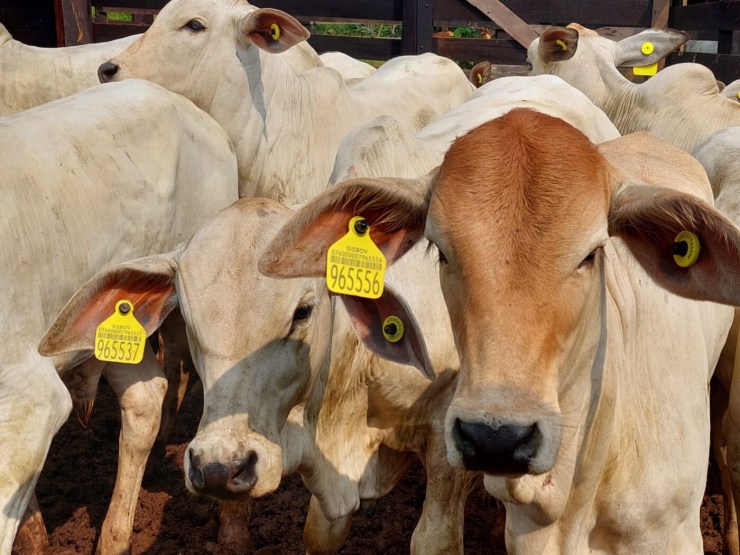
In a region of Texas where drought directly interferes with pasture stocking rates, water use and herd planning, producers and rural leaders from Mato Grosso visited the GKB Cattle facility in Desdemona this Tuesday (12). The property is a reference in bovine genetics and works with breeds such as Angus, Brangus, Hereford and Braford, selected with a focus on performance, meat quality and adaptation to the environment.
The visit was part of the program for the USA 2026 Technical Mission and placed the delegation in front of a production system different from the Brazilian one, but marked by challenges known to livestock farming in Mato Grosso, such as prolonged drought, the need for efficient use of pastures, strategic supplementation, and the search for more productive animals.
At GKB Cattle, participants observed practices in genetic selection, pasture management, use of irrigated areas, and data collection for decision-making. The farm uses performance data, body measurements, ultrasound, and genomic profiling to guide herd improvement. Irrigated areas are primarily directed towards more demanding categories, such as first-calf heifers and young animals in development.
According to Amarildo Merotti, vice-president of Famato and coordinator of the entity's Beef Cattle Commission, the experience demonstrated the strength of Texan genetics, but also reinforced the competitive potential of Brazilian livestock farming. "We are seeing what they have that is good and also valuing what we have in Brazil," stated Amarildo.
According to him, Brazil has significant advantages in terms of soil, productive area, and intensification capacity. The challenge, however, lies in transforming these conditions into greater value aggregation, productive organization, and economic efficiency.
"Brazil has everything it needs to move forward strongly. Actions like this help producers see what can be adapted to our reality," he assessed.
The president of the Juruena Rural Union, Marcelo Gueller, highlighted the practical application of genetics in breeding systems. A livestock farmer himself, he closely observed the use of crossbreeding with British breeds, especially Angus and Brangus, on Nelore cows. "We are learning how this genetics can add value to our production," said Marcelo.
He also highlighted the interest in supplementation and vertical integration strategies. According to the leader, the mission allows access to information that producers would hardly be able to obtain individually. "Through Famato and Senar, we come, learn, and then pass on the knowledge to other producers at the base," he stated.
Genetics also caught the attention of Carlinhos Rodrigues, president of the Rural Union of Paranaíta. He assessed that GKB Cattle works with broad selection criteria, considering carcass gain, productivity, meat quality, disease resistance, and climate adaptation. "They have a very intensive approach to genetics," he stated.
For Carlinhos, the search for animals better prepared to face periods of drought is directly linked to the reality of Mato Grosso, where livestock farming also experiences months of drought. "These are ideas that we were able to adapt to our reality," he added.
The president of the Rural Union of Cáceres, Aury Paulo, highlighted the organization of the property and the operational efficiency observed during the visit. According to him, the structure demonstrates planning, standardization, and control of production processes. "We see everything very well organized," he stated.
Aury also pointed out that some of the British genetics used in Brazil in industrial crossbreeding with Nelore cattle originate from work developed in the United States. He believes that the presence of rural union presidents on the mission increases the capacity to disseminate knowledge. "When we return to the grassroots level, we will be able to bring teachings and technologies to the producers," he said.
The president of the Rural Union of São Félix do Araguaia, Daniela Caetano de Brito, assessed that the visit highlighted differences between the production systems of the two countries, but also points of convergence, especially in nutrition, storage, and genetic improvement. "Livestock farming is integrated globally," she stated.
Daniela also highlighted that Brazil has made progress in professionalizing the activity, with support from programs such as Technical and Managerial Assistance, developed by Senar. For her, seeking references outside the country contributes to increasing the competitiveness of Brazilian production. "We need to seek improvements to have more competitiveness in the market," she added.
During the visit, GKB Cattle's herd manager, Andrew Conley, presented the main challenges faced by the operation in Texas. According to him, drought is among the most complex factors in the activity, as it requires constant planning regarding water, forage, and animal stocking rates.
Conley explained that the property maintains food reserves and uses irrigation strategically to ensure better performance of the most sensitive categories of animals. He also presented the use of genetic evaluations and individual animal information as tools to guide matings and herd selection.
The visit to GKB Cattle was part of the Texas contingent of the Senar/Famato USA 2026 Technical Mission, focused on high-performance beef cattle farming, genetics, reproduction, field management, and feedlot operations. For the delegation, the experience showed that competitiveness does not depend on a single technology, but on the combination of consistent genetics, management, nutrition, climate adaptation, and the ability to transform technical information into decisions within the farm.
The USA Technical Mission 2026 continues until May 21st, with visits to Texas and Nebraska. The program includes rural properties, universities, research centers, and institutions focused on genetics, reproductive biotechnology, integrated systems, and water use in agriculture.