EN
EN  PT_BR
PT_BR 
This procedure is one of the requirements of the bilateral trade protocol between Brazil and China. In 2025, the Asian country was the second largest destination for Brazilian tobacco, with imports of US$$ 577 million.
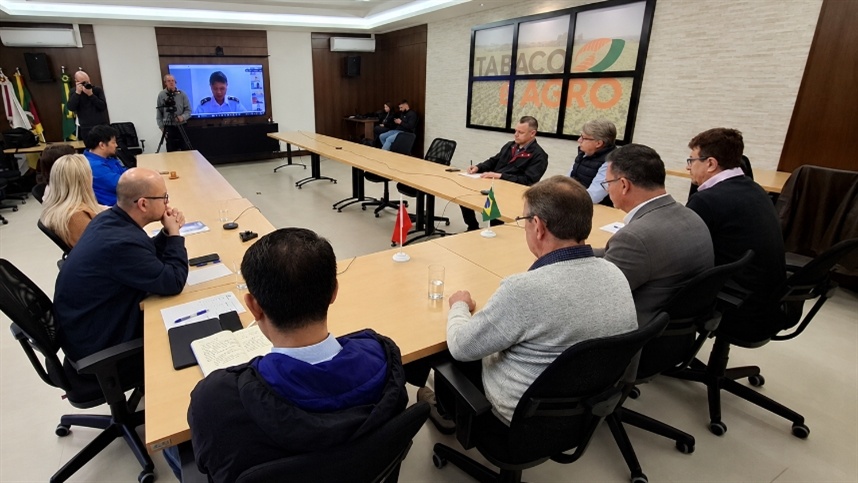
The Interstate Tobacco Industry Union (SindiTabaco) hosted this Thursday, September 17th, in Santa Cruz do Sul (RS), the closing meeting of the pre-inspection of the 2025/26 crop, one of the requirements foreseen in the bilateral trade protocol between Brazil and China. The meeting took place in a hybrid format, with the virtual participation of authorities from the General Administration of Customs of the People's Republic of China (GACC) and the Ministry of Agriculture, Livestock and Supply (MAPA).
Also participating were the president of SindiTabaco, Valmor Thesing; the president of China Tobacco International of Brazil (CTIB), Jin Quiang; the technical manager of the Laboratory of the Analytical Center of the University of Santa Cruz do Sul (UNISC), Adriana Dupont Schneider; the advisor to the Board of Directors of SindiTabaco, Carlos Sehn; as well as representatives of tobacco supply companies.
As in previous years, and as agreed with GACC, MAPA was responsible for collecting samples of processed tobacco and sending them to the UNISC Analytical Center for laboratory testing to verify the presence of the nine quarantine pests stipulated in the agreement before the product was shipped.
During the meeting, the MAPA representative, Roque Danieli, presented the activities carried out during the pre-inspection and the report submitted to GACC, detailing the procedures adopted in Brazil. “Over these 20 years, we have observed an increase in product quality, which we attribute mainly to the training provided. This year alone, more than 300 technicians have been trained,” Danieli reported.
Absence of pests
With the aim of verifying the presence of the nine quarantine pests foreseen in the agreement, the UNISC Analytical Center evaluated 52 batches from seven companies. The samples were examined for six types of insects, two weeds, and the fungus known as blue mold. No quarantine pests were detected in the analyzed samples, a result that meets the requirements foreseen in the bilateral protocol and allows the export process of the harvest to China to proceed.
According to the lead representative of GACC, Fayu Huang, the inspection was effective and there was significant progress in the quality of Brazilian tobacco products, especially regarding NTRM (Non-Tobacco Related Material), a term used to designate materials unrelated to tobacco. He stressed, however, the importance of raising awareness to further reduce the occurrence of these materials.
The president of CTIB pledged to reinforce, with tobacco suppliers, the importance of monitoring and traceability. According to him, the export of Brazilian tobacco to China depends on the issuance of the certificate by GACC. Until this step is completed, companies must maintain the necessary precautions to ensure product safety during the final storage phase.
China is an important destination.
The president of SindiTabaco, Valmor Thesing, reinforced the relevance of the Chinese market for the Brazilian tobacco sector. In 2025, China was the second largest destination for Brazilian tobacco, with imports of approximately US$$ 577 million. “For SindiTabaco and our seven associated companies that export volumes to China, this is a moment of great importance. China is one of our main markets and we are always attentive to the fulfillment of the established agreement,” he stated.
Thesing also highlighted that the elimination of NTRMs remains a concern for the sector. “We recently launched a new awareness campaign to minimize the contamination of tobacco with foreign materials. We are also committed to strengthening the monitoring and traceability of our product, in order to increase safety and compliance with the agreement,” reinforced the president of SindiTabaco.
Clean Tobacco Program
Concern about the presence of foreign materials in tobacco is addressed in the Clean Tobacco Program, an initiative that seeks to raise awareness among producers about the need to adopt measures to prevent these materials from being mixed with the product during crop management, harvesting, storage, sorting, or baling. Among the materials that can be found are raffia and plastic sack threads, grasses and other plant parts, feathers, insects, animal hair, paper, styrofoam, and twine. This procedure is one of the requirements of the bilateral trade protocol between Brazil and China. In 2025, the Asian country was the second largest destination for Brazilian tobacco, with imports of US$$ 577 million.
September 2026 – The Interstate Tobacco Industry Union (SindiTabaco) hosted this Thursday, September 17th, in Santa Cruz do Sul (RS), the closing meeting of the pre-inspection of the 2025/26 crop, one of the requirements foreseen in the bilateral trade protocol between Brazil and China. The meeting took place in a hybrid format, with the virtual participation of authorities from the General Administration of Customs of the People's Republic of China (GACC) and the Ministry of Agriculture, Livestock and Supply (MAPA).
Also participating were the president of SindiTabaco, Valmor Thesing; the president of China Tobacco International of Brazil (CTIB), Jin Quiang; the technical manager of the Laboratory of the Analytical Center of the University of Santa Cruz do Sul (UNISC), Adriana Dupont Schneider; the advisor to the Board of Directors of SindiTabaco, Carlos Sehn; as well as representatives of tobacco supply companies.
As in previous years, and as agreed with GACC, MAPA was responsible for collecting samples of processed tobacco and sending them to the UNISC Analytical Center for laboratory testing to verify the presence of the nine quarantine pests stipulated in the agreement before the product was shipped.
During the meeting, the MAPA representative, Roque Danieli, presented the activities carried out during the pre-inspection and the report submitted to GACC, detailing the procedures adopted in Brazil. “Over these 20 years, we have observed an increase in product quality, which we attribute mainly to the training provided. This year alone, more than 300 technicians have been trained,” Danieli reported.
Absence of pests
With the aim of verifying the presence of the nine quarantine pests foreseen in the agreement, the UNISC Analytical Center evaluated 52 batches from seven companies. The samples were examined for six types of insects, two weeds, and the fungus known as blue mold. No quarantine pests were detected in the analyzed samples, a result that meets the requirements foreseen in the bilateral protocol and allows the export process of the harvest to China to proceed.
According to the lead representative of GACC, Fayu Huang, the inspection was effective and there was significant progress in the quality of Brazilian tobacco products, especially regarding NTRM (Non-Tobacco Related Material), a term used to designate materials unrelated to tobacco. He stressed, however, the importance of raising awareness to further reduce the occurrence of these materials.
The president of CTIB pledged to reinforce, with tobacco suppliers, the importance of monitoring and traceability. According to him, the export of Brazilian tobacco to China depends on the issuance of the certificate by GACC. Until this step is completed, companies must maintain the necessary precautions to ensure product safety during the final storage phase.
China is an important destination.
The president of SindiTabaco, Valmor Thesing, reinforced the relevance of the Chinese market for the Brazilian tobacco sector. In 2025, China was the second largest destination for Brazilian tobacco, with imports of approximately US$$ 577 million. “For SindiTabaco and our seven associated companies that export volumes to China, this is a moment of great importance. China is one of our main markets and we are always attentive to the fulfillment of the established agreement,” he stated.
Thesing also highlighted that the elimination of NTRMs remains a concern for the sector. “We recently launched a new awareness campaign to minimize the contamination of tobacco with foreign materials. We are also committed to strengthening the monitoring and traceability of our product, in order to increase safety and compliance with the agreement,” reinforced the president of SindiTabaco.
Clean Tobacco Program
Concern about the presence of foreign materials in tobacco is addressed in the Clean Tobacco Program, an initiative that seeks to raise awareness among producers about the need to adopt measures to prevent these materials from being mixed with the product during crop management, harvesting, storage, sorting, or baling. Among the materials that can be found are raffia and plastic bag threads, grasses and other plant parts, feathers, insects, animal hair, paper, styrofoam, and twine.