EN
EN  PT_BR
PT_BR 
The presence of the Paraná Rural Development Institute (IDR-Paraná) at the Port of Paranaguá, on the state's coast, is a strategic pillar for Paraná's agribusiness, consolidating the trust of the world's most demanding markets. The organization is responsible for auditing the reception and quality control of soybean, corn, and soybean meal shipments arriving at the Sorting Yard, as well as for classifying these products transported by rail.
Historically, this activity began in the mid-1980s, under the legacy of the former Paraná Product Classification Company (Claspar), and was fundamental for the standardization of grains and the guarantee that the cargo loaded onto ships meets all the required quality standards.
 In the intense logistical flow of the Sorting Yard, through which trucks must pass to unload at the port, IDR-Paraná acts as a supervisory arm. A private company contracted by the Association of Terminals of the Paranaguá Export Corridor (ATEXP) performs the operational service of quality control and sample collection from the thousands of trucks that arrive daily. IDR-PR plays the crucial role of auditing, as the "eye of the State" in the port, ensuring that the analyses carried out by the private initiative strictly follow the current standards, guaranteeing fairness in the classification for both producers and buyers.
The coordinator of the Sorting Yard, Bruno de Paula Guimarães, from the public company Portos do Paraná, explains that classification plays a decisive role in the quality of exports. “Trucks must pass through the yard to ensure the quality of their cargo. Each truck is analyzed, and a sample is collected for analysis. If the cargo is deemed suitable, it proceeds to the Export Corridor,” he informs. “And the role of IDR-Paraná is fundamental in auditing the work of the classification company and ensuring that the required procedures and reliability standards are being followed throughout the process,” Guimarães emphasizes.
Unlike the road transport system, the classification service in the rail sector is the sole responsibility of IDR-Paraná, which has partnerships with private controlling companies. The Institute maintains its technical teams operating directly in the train area, auditing the classification process carried out by the private controlling companies accredited by it. The volume of cargo is massive and demands absolute precision. This direct state involvement in the rail transport sector ensures that the flow of large trains loaded with soybeans, corn, and bran maintains the necessary technical compliance for supplying ships, leaving no room for error.
Differentiated model
 According to Wagner Spirandelli, quality and classification manager at IDR-Paraná, the Port of Paranaguá differs from other ports in Brazil because it is the only one with an export "pool" system. "The logistics model is designed to ensure that grains and bran reach the ships through the Export Corridor. This involves stockpiling grains so that shipments receive products from all terminals of different origins. To ensure quality is maintained, a quality control mechanism was created for the formation of export stocks for both modes of transport. In rail transport, IDR-Paraná is fully responsible for quality. It is ultimately responsible for receiving the stocks that arrive there," explains Spirandelli.
State-of-the-art infrastructure
To support this technical rigor, IDR-Paraná maintains a state-of-the-art infrastructure within the port complex. In addition to maintaining teams present 24 hours a day at operational points in the Sorting Yard and the railway sector, Paranaguá has a specialized laboratory for sample analysis, staffed by its own laboratory technicians. This technological center performs detailed physicochemical tests that go beyond the simple visual classification of grains. The laboratory is responsible for certifying the intrinsic quality of the product, such as total protein content, residual fat, and moisture, as key tests, ensuring that the standards required by international contracts are met before shipment.
 “We perform a complete analysis of the bran,” says Juliana Costa, a laboratory technician at IDR-Paraná. “When the sample arrives, which may be from a batch or just a truck or wagon, we process the grinding, then weigh it, test the amount of protein, moisture, fat, presence of fiber, ash, and even sand present in the sample. The responsibility is great. Whether we like it or not, the names of Paraná and Brazil are going along with the exported cargo. We always strive to send the best possible bran abroad,” she concludes.
One of the competitive advantages ensured by the laboratory is the precise analysis of protein levels in soybean meal. In a global scenario where animal and human nutrition demands exact specifications, guaranteeing the amount of protein in accordance with international requirements is what differentiates the Paraná product in "premium" markets, such as the European and Asian markets.
Few incidents
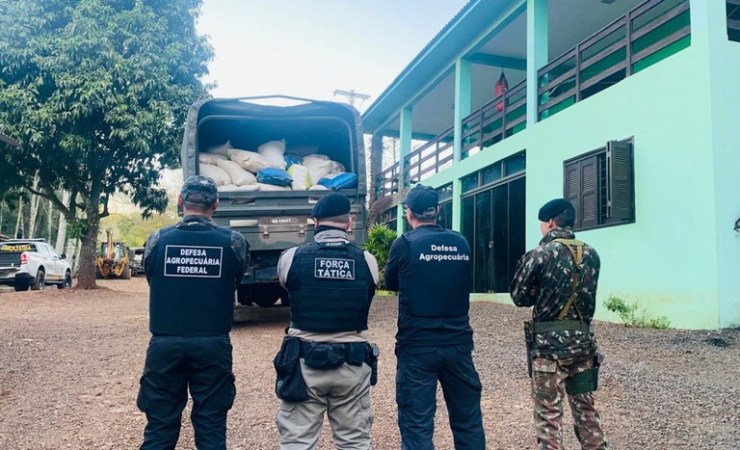
Working at the port for 37 years, Nilton Cezar Gonçalves, a classification technician at IDR-Paraná who began his career in operations collecting grains and now coordinates the work, says that the presence of technical teams on site helps maintain the competitive advantage of Paraná's products. “Incidents with non-standard cargo are now very isolated and random, with a very quick response from the team, even when there is a suspected crime. We have partnerships with the Ministry of Agriculture, the Federal Police, port authorities, the Military Police, and the Municipal Guard, who act promptly. Our technicians are also very experienced, with the ability to identify any anomaly in a cargo immediately,” Gonçalves emphasizes.
Screening
 Strict oversight, encompassing soybeans, corn, and soybean meal, prevents economic losses and protects Paraná's reputation. And this work is reflected in the numbers. In 2025, the Public Sorting Yard at the Port of Paranaguá reached a new record by receiving 507,915 trucks, representing 29.51 more than in 2024 (392,214). The site covers 330,000 m² and has 1,000 parking spaces.
Another record achieved by the unit last year was the daily traffic volume. In 24 hours, between July 21st and 22nd, 2,523 trucks loaded with grains and bran passed through the yard, 4% more than the previous record, registered in July 2023, when 2,456 vehicles accessed the site. This milestone successfully surpassed the unit's projected capacity of 2,500 trucks.
All this flow is meticulously controlled by the Carga Online system, which informs companies of the day and time window in which the truck can access the sorting area. This prevents vehicles from traveling on highways in advance, making unnecessary stops that can generate queues or slow traffic. The same system controls the destination of trucks to export terminals, avoiding impacts on traffic in the port area.
In 2025, the commodity that moved the most through the Sorting Yard was soybeans. More than 611 TP4T of the trucks (306,801) that accessed the unit were loaded with the product. Soybean meal came in second place, with 24.51 TP4T (122,647 trucks), followed by corn (69,978 trucks). The months of March and July registered the highest volumes of vehicles.
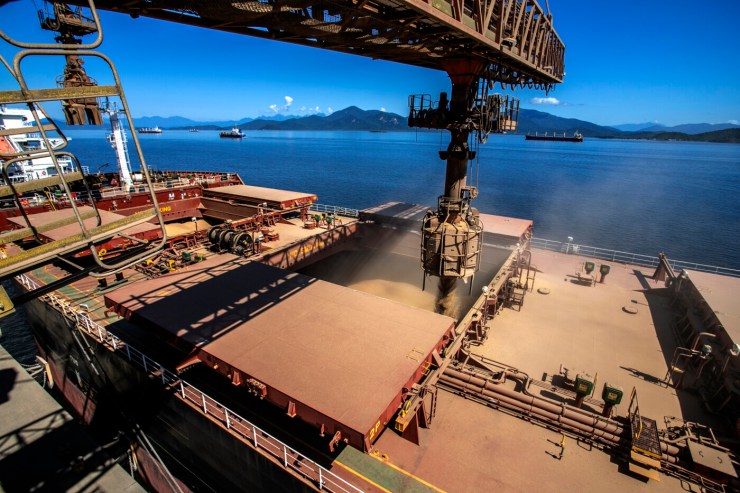
According to Portos do Paraná, it was the logistical strategies in the Sorting Yard that allowed this flow, with a more agile operation up to the loading of cargo. Another factor responsible for the more intense movement in the yard, according to Portos do Paraná, was the greater loading capacity of ships in a single operation, due to the increase in operational draft — the distance between the water surface and the deepest point of the vessel. In September 2025, there was an increase in the operational draft in the solid bulk berths, which went from 13.1 meters to 13.3 meters. The expansion allowed an average growth of up to 1,500 tons per ship.
This is how commodities exported through the Port of Paranaguá receive a premium in their prices on the Chicago Stock Exchange (NYSE Chicago), leveraged by three pillars: speed in ship loading, confidence in weight, and guarantee of contracted quality.