EN
EN  PT_BR
PT_BR 
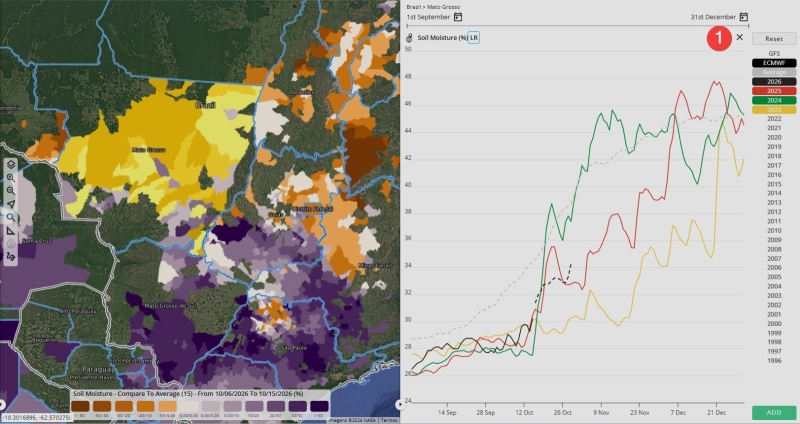
Despite the rainfall recorded in recent weeks, soil moisture remains below the historical average in much of Mato Grosso, keeping attention focused on the progress of soybean planting in the 2026/27 crop season. According to analyses by EarthDaily, a company specializing in agricultural satellite monitoring, water recovery is occurring unevenly in the Central-West region, with more favorable conditions in Goiás and Mato Grosso do Sul.
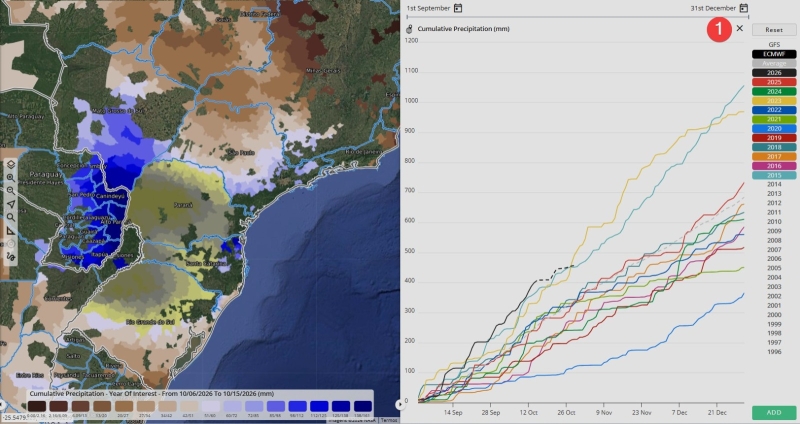
Over the past ten days, the highest rainfall amounts have been concentrated in southern Brazil, especially in Paraná, Santa Catarina, and Rio Grande do Sul, with accumulations exceeding 70 millimeters in some locations. Rainfall was also above the historical average in areas of the Central-West region, contributing to the recovery of soil moisture and the initial establishment of soybean and corn crops. However, the uneven distribution of rainfall still limits recovery in important producing regions.
“In Mato Grosso, the country's main soybean-producing state, current soil moisture levels remain below the historical average, although they show improvement compared to previous weeks. The forecast from the European meteorological model (ECMWF) for October 22nd indicates little further recovery, with persistent water deficits in much of the agricultural area. Furthermore, the ECMWF and GFS models project below-average rainfall for the next ten days, a scenario that could restrict the pace of planting and the initial development of crops,” explains Felippe Reis, crop analyst at EarthDaily.
Conversely, Goiás and Mato Grosso do Sul have registered a significant recovery in moisture since the beginning of October, reaching levels higher than the historical average and those observed in the same period of 2023, 2024, and 2025. The forecast indicates the maintenance of favorable conditions in the coming weeks, reducing the risk of water restrictions for the establishment of soybeans and corn.
In MATOPIBA, a region encompassing areas of Maranhão, Tocantins, Piauí, and Bahia, water availability remains below average in important producing areas, especially in Tocantins and western Bahia. Despite a slight recovery in October, levels remain lower than those recorded in the previous two years. In northwestern Minas Gerais, where there is also a moisture deficit, the ECMWF forecast indicates a gradual recovery, with the possibility of intensified rainfall in the last week of October.
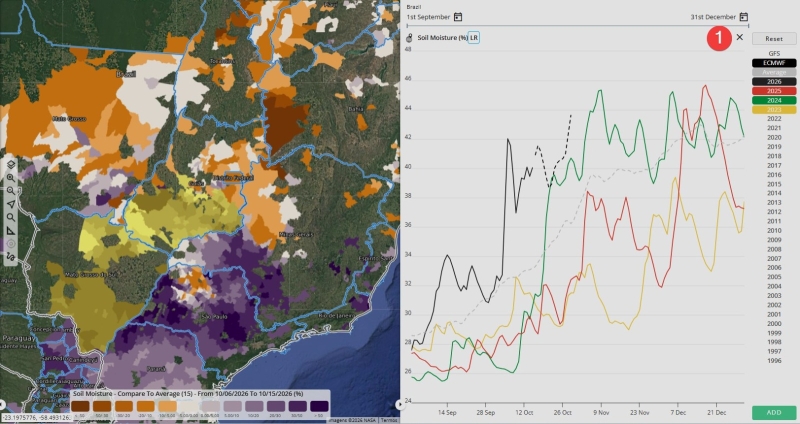
Temperatures near or below average across much of the South-Central region also contribute to soil moisture conservation by reducing evaporative demand. This behavior favors the establishment of summer crops in regions where rainfall has already been sufficient to replenish water availability.
Southern Brazil records highest rainfall total in the last 11 years.
While parts of the Midwest still depend on more regular rainfall, excessive precipitation is worrying wheat producers in the South. According to EarthDaily, the accumulated volume since September has reached its highest level in the last 11 years, even surpassing the records of 2015 and 2023, years marked by the influence of El Niño.
“The persistent rainfall may hinder harvesting operations and compromise grain quality, especially in Santa Catarina and Rio Grande do Sul, where harvesting occurs later than in Paraná. However, for the next ten days, weather models indicate below-average rainfall in Rio Grande do Sul, which could favor the resumption of fieldwork,” explains Felippe Reis, crop analyst at EarthDaily.
Next few days
For the next few days, the forecast of above-average rainfall in areas of Goiás, Minas Gerais, São Paulo, and Paraná tends to favor the maintenance of soil moisture and the initial development of summer crops. Mato Grosso, on the other hand, remains the main point of concern in the Central-West region, given the prospect of insufficient rainfall for a more consistent recovery of water availability.