EN
EN  PT_BR
PT_BR 
Projections for the 2025/2026 Brazilian grain harvest point to a new cycle of strong production and consolidate Brazil among the world's leading food suppliers. Even with occasional variations caused by climatic factors, the expectation is that the country will reach a volume close to a new record.
According to estimates from the National Supply Company, the national production of grains, cereals, and legumes should be between 353.1 million and 354.7 million tons. This volume represents growth of approximately 0.8% to 1% compared to the 2024/2025 harvest.
The prospect of high production comes at a time of strong international demand, especially for soybeans, one of the main products of Brazilian agribusiness.
Exports gain momentum.

Lívia Quixabeira, a lawyer specializing in Agribusiness Law, states: “There are risks that can be avoided, and a well-drafted contract defines who assumes responsibility for transportation, how the grain quality analysis will be conducted, which legislation will apply, and where any disputes will be resolved.” – Photo: Personal archive
Activity at the ports already signals the impact of the new harvest on foreign trade. According to the shipping schedule released by the National Association of Cereal Exporters, Brazil is expected to ship 16.1 million tons of soybeans in March alone.
According to economist and business executive Israel Freitas, the beginning of the year was marked by climatic challenges, with excessive rainfall causing a natural delay in the harvest in some producing regions. “Despite the complicated start to the year, marked by a lot of rain, there was a natural delay in the harvest cycle. But when we look at the coming months, especially March, we see a very strong increase in activity at Brazilian ports, even compared to the same period last year,” he states.
According to him, excess moisture can impact grain quality and influence export flows, especially in long-distance operations. “We have a very long sea voyage, and the soybeans don't always go straight to crushing. Often they go through a storage period. Even so, we observe a shift in supply and demand, with the international market opening up opportunities for Brazil to export to countries other than China,” he explains.
Recent record in foreign sales

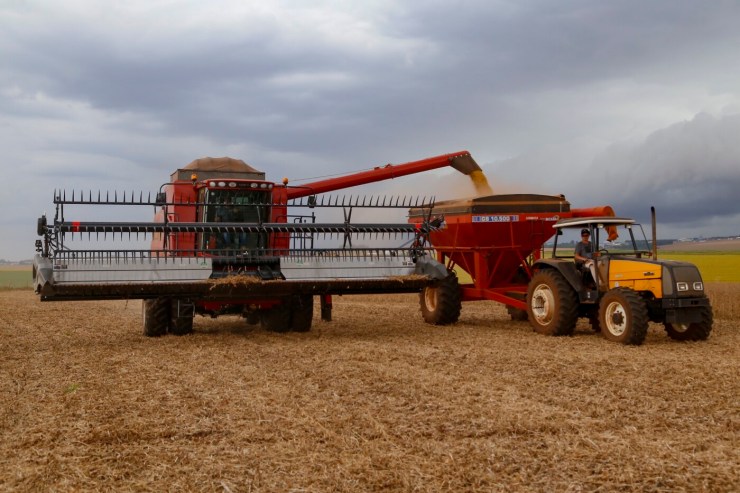
Photo: Claudio Neves/Ports of Paraná
Data from the Foreign Trade Secretariat shows that the country shipped 3.38 million tons of soybeans in December 2025, a volume 59.3% higher than that recorded in the same month of 2024.
Last year, Brazil recorded record exports of approximately 108.68 million tons of soybeans. This volume represents growth of about 11.71% compared to the previous cycle. When soybean meal and oil are also considered, the total exported exceeds 130 million tons.
The expectation for 2026 is that this leading role in international trade will be maintained, supported by the expansion of the planted area and the competitiveness of Brazilian production.
Legal certainty in operations

Economist and business executive Israel Freitas: “Despite the complicated start to the year, marked by a lot of rain, there was a natural delay in the harvest cycle. But when we look at the coming months, especially March, we see a very strong increase in activity at Brazilian ports, even compared to the same period last year” – Photo: Personal archive
With the increase in trading volume and the growing presence of investors and trading companies in the sector, experts point out that legal certainty is becoming increasingly relevant in export operations.
According to Lívia Quixabeira, a lawyer specializing in Agribusiness Law, well-structured contracts are fundamental to reducing risks and avoiding losses throughout the commercial chain. “Investors already deal with unavoidable risks, such as the effects of weather on crops. But there are risks that can be avoided, and a well-drafted contract defines who assumes responsibility for transportation, how the quality of the grains will be analyzed, which legislation will be applied, and where any disputes will be resolved,” she emphasizes.
According to her, international operations require rigorous legal and financial organization. “It’s necessary to have a well-organized corporate structure, detailed contracts and objective quality criteria, as well as solid payment guarantees. It’s also important to foresee conflict resolution mechanisms, such as international arbitration, in addition to careful management of exchange rate risk and the documentation of operations,” she emphasizes.
Given the prospect of a robust harvest and the growth of exports, experts believe that logistical efficiency, risk management, and legal security will be decisive factors in sustaining the competitiveness of Brazilian agribusiness in the global market.