EN
EN  PT_BR
PT_BR 
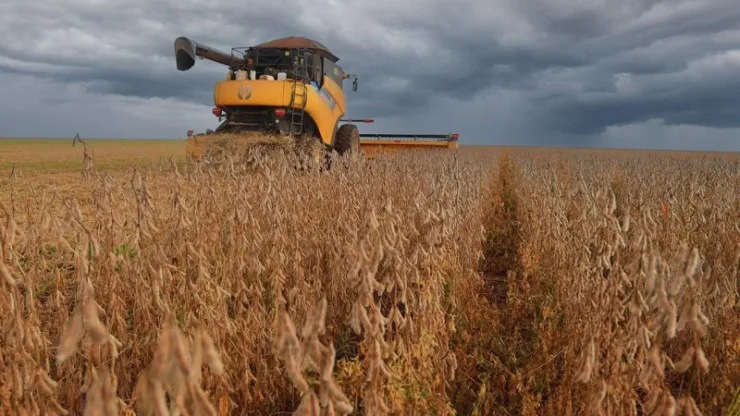
Soybean productivity in Rio Grande do Sul has been below the average recorded in other Brazilian states, especially in the last five years. The assessment was presented this Tuesday (10) by the founder of Veeries and specialist in market intelligence for agribusiness, Marcos Rubin, during the 36th National Soybean Forum, held in the Central Auditorium of Expodireto Cotrijal, in Não-Me-Toque (RS). The event was part of the technical program of the 26th edition of Expodireto Cotrijal and brought together specialists to discuss competitiveness, productive scenario and prospects for the soybean and corn chains.
In his presentation “2026: The New Cycle of Soybeans and Corn: Between Record Harvests and Changes in Demand,” Rubin presented figures and tools focused on analyzing the agricultural market. He displayed data on soybean performance in recent years and pointed out that productivity in Rio Grande do Sul has been below the average observed in other states. According to Rubin, climatic factors have contributed to this scenario. “In addition to the climate, there has been less money available to invest in new crops,” he emphasized.

Guillermo Dawson Jr: “The current situation of the soybean market is a constant concern, ranging from climate to trade issues, in a global context of wars” – Photos: Nestor Tipa Júnior/AgroEffective/Press Release
During the presentation, Rubin also drew attention to the potential of producing biofuels from grains as an alternative to expand the demand for soybeans. “The new China for Brazil is biodiesel production. In Brazil, there is a considerable domestic market for biodiesel. We have a gigantic opportunity. So, if we apply biofuels in the future, they will be the main driver of the growth in soybean demand in Brazil in the coming years,” he concluded.
Rubin also presented comparative graphs on the evolution of soybean production in the international scenario. According to him, Brazil has significantly increased its production in the last 10 years compared to the United States. Regarding future prospects, the expert stated that he is beginning to see more positive signs for the second half of the year, but highlighted factors of uncertainty in the international scenario. “I think there are imponderable factors such as the consequences of the Iran-US war. There is a factor that is not beneficial in this war issue, which is fertilizer. We don't know for how long, but prices have already risen,” he noted.
In addition to market analysis, the forum also addressed challenges related to infrastructure and logistics for Brazilian agribusiness. The program included the lecture "From Adversity to Competitive Advantage: The New Strategic Cycle of TERMASA," presented by the vice-president of Cooperativa Central Gaúcha Ltda. (CCGL) and the Termasa-Tergrasa port terminals, Guillermo Dawson Jr.

Marcos Rubin: "Besides the weather, there has been less money available to invest in new crops."
During the presentation, Dawson Jr. addressed the role of port infrastructure and integrated logistics in the competitiveness of Brazilian agribusiness. “The current situation of soybeans is a constant concern, ranging from climate to trade issues, in a global context of wars. It is up to us to provide the best logistical infrastructure conditions so that soybeans can enter the markets,” he stated.
The director also highlighted the history of the Termasa-Tergrasa terminals, located in the Port of Rio Grande. According to him, the project emerged in the late 1960s from an initiative of cooperative members seeking alternatives for the outflow of grain production. The terminal became the country's first bulk cargo terminal in 1972. Currently, Termasa is undergoing reconstruction, with an investment of R$600 million, following an accident involving a ship. The works are expected to last until October 2026.
At the opening of the forum, the president of the Federation of Agricultural Cooperatives of Rio Grande do Sul (FecoAgro/RS), Paulo Pires, highlighted the importance of the event, which is in its 36th edition and is taking place for the 26th consecutive year within Expodireto Cotrijal. “I think the most important aspect of the Soybean Forum is the interaction. We basically have representatives from cooperatives, companies, the financial system, and it is in this context that we have a very large selection of debates converging towards solving problems,” he emphasized.
The 36th National Soybean Forum is jointly promoted by FecoAgro/RS, Cotrijal and CCGL, with support from the Ocergs/Sescoop-RS System.