EN
EN  PT_BR
PT_BR 
The first outbreak of Asian soybean rust this season was recorded in Mato Grosso do Sul last week, according to monitoring by the Antirust Consortium, maintained by Embrapa and partners. The commercial crop, located in the municipality of Sete Quedas, in the Southwest Region, is in the R5 phenological stage, marked by the beginning of grain filling, and was planted in the second half of September. The disease was confirmed by the MS Foundation.
“Climatic conditions such as excessive heat and high humidity favor the increase in the weed population and intensify the spread of fungal spores, which occurs mainly through the wind, contributing to the emergence of new outbreaks,” explained the technical coordinator of Aprosoja/MS, Gabriel Balta.
Asian soybean rust, caused by the fungus Phakopsora pachyrhiziSoybean rust settles on soybean plants, forming small lesions that initially appear reddish-brown on the underside of the leaves. As the infection progresses, these structures evolve into darkened spots distributed across the entire leaf surface, causing a reduction in the photosynthetically active area, necrosis, and premature defoliation. In severe cases, the disease can compromise up to 90% of production if left uncontrolled, making rust one of the most aggressive threats to the crop.
Controlling Asian soybean rust requires integrated and ongoing management, which includes complying with fallow periods, crop rotation, sowing within the window indicated by the Ministry of Agriculture and Livestock (MAPA), adopting resistant cultivars, constantly monitoring the areas, and assertive intervention with specific fungicides when necessary.
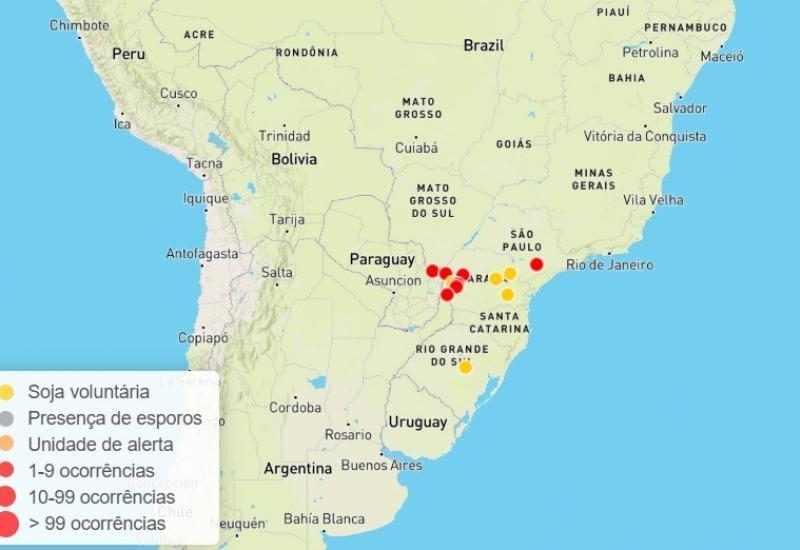
Nationally, this year eight outbreaks of the disease were confirmed, six in Paraná and one in São Paulo, in addition to the occurrence in Mato Grosso do Sul. In the 2024/2025 harvest, Mato Grosso do Sul accounted for 12 occurrences and ranked third among the states with the highest number of notifications, behind only Paraná and Rio Grande do Sul, which recorded 66 and 25 cases, respectively. In total, Brazil recorded 124 occurrences.