EN
EN  PT_BR
PT_BR 
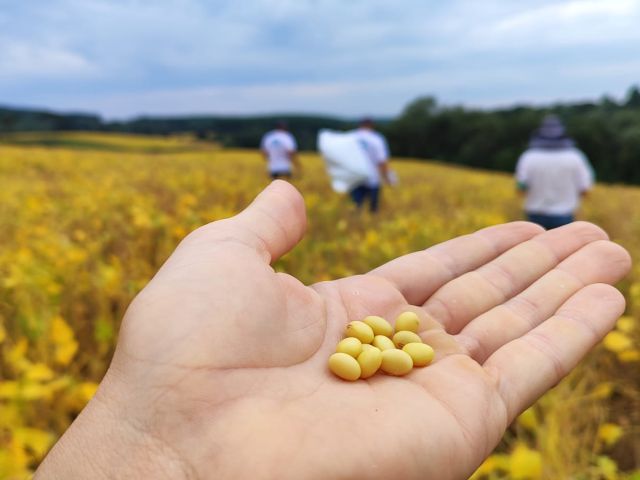
Santa Rosa (RS), known as the National Cradle of Soy, is the focus of the sector's attention in the first half of May with the holding of Fenasoja, which celebrates 60 years at the Alfredo Leandro Carlson Exhibition Park. As part of the program, the National Closing Ceremony of the Soy Harvest was held last Friday (1st), on which occasion Emater/RS-Ascar presented the second estimate of the 2025/2026 crop for soy and corn.
In the Santa Rosa region, the soybean harvest has already reached 77% of the cultivated area. Current estimates indicate 784,008 hectares planted, with an average yield of 2,350 kg per hectare and a projected production of 1,842,419 tons.

The figures, presented by the president of Emater/RS, Claudinei Baldissera, show that the current estimate for soybean production in the region is 784,008 hectares: "The summer soybean crop, an important component of regional agriculture, demonstrates sensitivity to climatic conditions."
According to the president of Emater/RS, Claudinei Baldissera, the crop performance reflects the irregular weather patterns throughout the cycle. "The summer soybean crop, an important component of regional agriculture, demonstrates sensitivity to weather conditions. The data reveals a challenging scenario," he states.
The survey also indicates that 14% of the crops are in the maturation phase, 8% in grain filling, and 1% in flowering. Productivity variability is significant, with records ranging from 1,200 to 4,200 kg per hectare, influenced by factors such as rainfall distribution, management, and soil characteristics. "It is important to highlight the regional heterogeneity, with significant variations, especially due to rainfall scarcity, which directly impacts crop performance," says Baldissera.
Corn production forecast revised upwards.
For corn, the current estimate indicates a production of 1,199,830 tons, an increase of 66,822 tons compared to the initial projection. The cultivated area was revised from 137,501 hectares to 150,204 hectares, an increase of 12,703 hectares.

In the Santa Rosa region, the soybean harvest has already reached 77% of the total cultivated area, and in the case of corn, this percentage reaches 94%.
The estimated average productivity is 7,988 kg per hectare, a decrease of 3.11 TP4T compared to the 8,240 kg per hectare projected at the beginning of the cycle. "Corn has shown greater stability in production, especially when cultivated within the appropriate window and with suitable management practices," says the president of Emater.
The cereal harvest is practically complete in the region, with 94% of the area already harvested. Small plots remain in the final stages of the cycle: 4% in grain filling, 1% in flowering, and 1% in maturation. Recent rains have favored crop development, with no significant reports of pests or diseases so far.
Despite this, attention is being paid to the climate risk in the final stages. "There is constant concern about weather events, and the possibility of early frosts could interfere with the final phase of the crops," warns Baldissera.
State scenario points to losses in soybean production.
In Rio Grande do Sul, the area planted with soybeans is estimated at 6,624,988 hectares, with an average productivity of 2,871 kg per hectare and a total production of 19,017,426 tons. For corn, the area reaches 803,019 hectares, with a productivity of 7,424 kg per hectare and a projected production of 5,961,639 tons. “The reduction in production and its financial impacts are notable, with significant losses, which reinforces the need to assess climate vulnerability and advance public policies focused on irrigation, soil and water management and conservation,” emphasizes the president of Emater/RS.