EN
EN  PT_BR
PT_BR 
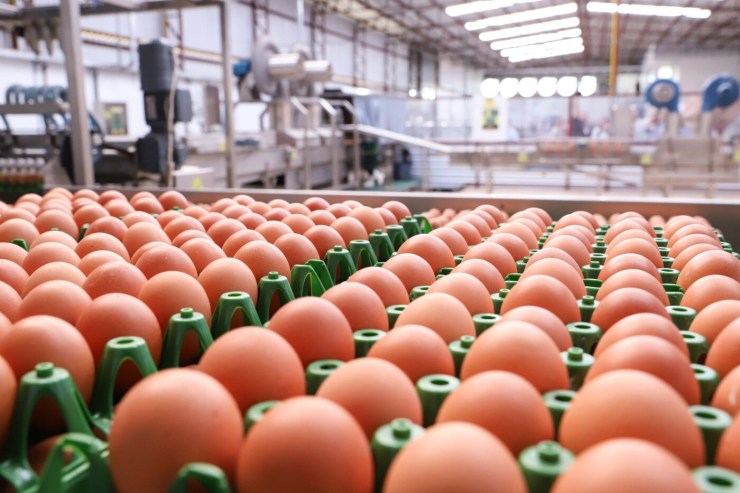
Brazilian exports of eggs and egg products lost momentum in the first four months of 2026. Data from Agrostat Brasil, from the Ministry of Agriculture and Livestock (Mapa), shows that the country shipped 16,863 tons between January and April, a volume 14.51% lower than that recorded in the same period of 2025, when 19,692 tons were exported.

Photo: Rodrigo Felix Leal
Despite the decline in shipments, foreign exchange revenue showed growth. Export revenue reached US$68.692 million in the first four months of this year, an increase of US$3.51 compared to the US$66.377 million recorded in the same period last year.
The information is contained in the Conjunctural Bulletin of the Department of Rural Economy (Deral), of the State Secretariat of Agriculture and Supply (Seab), prepared by the veterinarian and market analyst Roberto Carlos Andrade e Silva.
According to the analyst, the result demonstrates that the drop in export volume did not prevent the growth in revenue obtained by the sector. "From January to April 2026, national egg exports reached 16,863 tons, a volume 14.51% lower than that recorded in the same period of 2025. However, the revenue corresponding to the volume sold increased by 3.51%," he highlights.
The so-called egg complex encompasses fertile eggs intended for incubation, day-old chicks, fresh eggs with shells, cooked and dried eggs, fresh and cooked egg yolks, and egg albumin. Among these products, fertile eggs for incubation and fresh eggs for consumption represent the largest share of Brazilian exports.

Photo: Rodrigo Felix Leal
Paraná is growing above the national average.
While national performance was marked by a decline in shipments, Paraná expanded its participation in the international market.
Between January and April, the state exported 2,908 tons of eggs and egg products, a volume 18.5% higher than that recorded in the same period of 2025, when shipments totaled 2,454 tons. Foreign exchange revenue reached US$17.106 million, an increase of US$45% over the US$11.795 million obtained a year earlier.
"Paraná appears as the second largest national exporter, with volume and revenue exceeding those recorded in the same period of the previous year," emphasizes Roberto Carlos Andrade e Silva.
The state occupies second place in the Brazilian ranking of exports in the sector, behind only São Paulo, which shipped 5,377 tons and earned US$28.117 million.
Next in line are Minas Gerais, with 2,373 tons exported and revenue of US$3.959 million; Rio Grande do Sul, with 2,132 tons and revenue of US$8.247 million; and Mato Grosso, with 1,811 tons and revenue of US$2.263 million.
Among the country's five main exporters, only Mato Grosso registered a decrease in shipments. São Paulo increased its export volume by 3.8%, Minas Gerais by 22.5%, and Rio Grande do Sul by 22.5%.

Photo: Disclosure
South in 36%.
Chile takes the lead among buyers.
The international landscape also presented important changes. Chile became the main importer of Brazilian eggs and egg products in the first four months of 2026.
The country acquired 3,133 tons, generating US$7.042 million. Compared to the same period last year, Chilean purchases grew by 74.21% in volume and 52.6% in revenue. "Chile, the United Arab Emirates, Senegal, and Paraguay showed significant growth in imports of Brazilian eggs and egg products during the analyzed period," notes the Deral analyst.

Photo: Rodrigo Felix Leal
After Chile, Mexico, the United Arab Emirates, Senegal, Japan, and Paraguay appear among the main destinations for Brazilian products.
US tariffs alter trade flows.
The main change observed in the international market was the loss of ground for the United States as a buyer of Brazilian eggs.
In July 2025, the U.S. government announced a 50% tariff on various Brazilian products, including eggs. The measure went into effect in August of that year.
At the time, the United States was facing supply difficulties caused by outbreaks of highly pathogenic avian influenza (H5N1), which led to the culling of millions of commercial birds over the past few years.
According to Roberto Carlos Andrade e Silva, the United States had become a relevant market for Brazilian eggs. "In the first four months of 2025, the United States stood out as the main importer of egg products from Brazil, with 5,591 tons and foreign exchange revenue of US$11.81 million," he highlights.
In November 2025, some Brazilian products were removed from the list of items subject to tariffs by the United States. However, eggs, instant coffee, honey, fish, and grapes remained subject to tariffs.

Photo: Rodrigo Felix Leal
Additional charge.
The impact on the Brazilian supply chain was immediate. In the first four months of 2026, US imports of Brazilian eggs fell to just 103 tons, with revenue of US$81,600. "Since the maintenance of the tariff on eggs, the adverse effects of the tariff increase continue to negatively impact the Brazilian egg-laying poultry industry," says the analyst.
Market under reconstruction
According to Roberto Carlos Andrade e Silva, the numbers indicate that the US tariffs interrupted an expansion process that could have consolidated the United States as one of the main destinations for Brazilian eggs. "The available information suggests that the American tariff resulted in a reduction in the physical volume of exported eggs for consumption, interrupting the possibilities of conquering and consolidating a buyer's market for Brazilian eggs," he emphasizes.
Even in this scenario, the growth of exports from Paraná and the expansion of sales to other destinations show that the sector is seeking to diversify markets and reduce its dependence on specific buyers, a strategy considered fundamental to sustaining export growth in the coming years.